

For the Record
In an age of streaming, why vinyl?
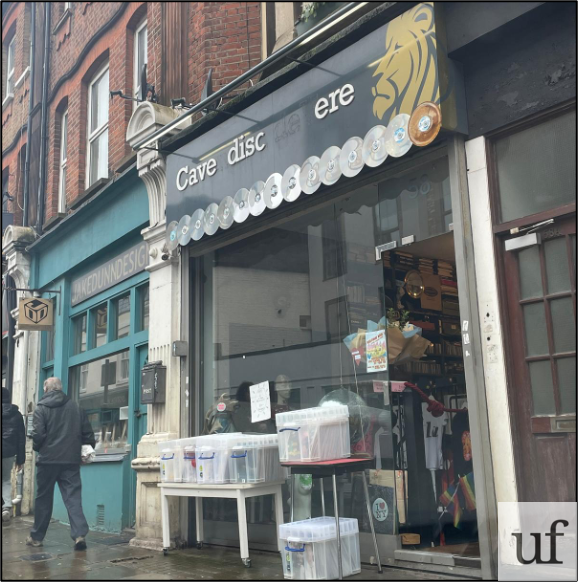
“It’s a bit like selling drugs,” Mark said. “It’s people’s fix. They may not drink or smoke but they have a habit – and there are worse habits!”
“So that makes you a record dealer?” I asked. He didn’t need to respond: the customers flicking through his boxes of pre-loved vinyl until their eyes lit up told me all I needed to know.
At a time when our favourite artists live in our pocket for £12.99 a month, why are we still obsessed with vinyl records when they are less convenient and typically more expensive?
A ‘Thing’
Mark’s record shop in Crystal Palace is no bigger than a living room and there is no space spared. Boxes of pre-loved vinyl cover the walls, surrounding an island in the middle dedicated to some of the heavy-hitters: Billie, the Beatles and Bob.
The patrons are an eclectic bunch, young and old. From the moment I arrived, a cocktail of regulars and newcomers had drifted in and out; some curiously drawn in by the echoes leaking onto the street, others partaking in a weekend ritual. I’d once been both.
Jess and Ed were two twenty-somethings visiting Mark’s shop for the first time. They wanted to add to the collection that they had inherited from their parents.
“I love a bit of info,” said Ed, opening up a double-album. “It makes me actually think about what the thing is.”
His words mirrored what another couple had expressed to me moments earlier when they spoke about being able to read the lyrics of songs on the record sleeve.
You might ask: Can you not just get all that on your phone?
“It feels more containable… and the world is very uncontainable,” Jess said. “Endless scrolling, endless collections of photographs that you’ll never come back to… whereas if you have a thing it’s a bit more conceivable.”
As our tech grows ever more expedient in pursuit of what the manufacturers euphemistically call ‘progress,’ Jess and Ed - like many of their generational comrades - are left craving something a bit more concrete.
Something slower. More tangible. Something that feels like it really exists.
Jess’s emphasis on the word ‘thing’ might fly overhead for those who were actually brought up on tactile media like records, film photo albums and grainy camcorders. In other words, things.
But for a younger bunch, whose childhood coalesced with the birth of the digital world and their teens with its gradual incursion into our daily lives, a thing might be closer to an affirmation of being alive than simply a vessel of audio or visual.
Being There
“Crikey! I haven’t been inside that ballroom since – no, please carry on…” Tommy cut himself off, apologising for going off topic. He had been rifling through the £1 box outside the front of the shop before I had interrupted him. But no sooner had I asked him why younger generations were getting into vinyl than we had diverted into a conversation about the Rivoli Ballroom, a classic South London music venue.
“What’s the dress code?” he continued in earnest. “Does it still have the old décor, the velvety-whatever-it-was?” I smiled and nodded, discarding a notebook of meticulously written questions into my pocket and beginning to fear that we had strayed from the path.
“I’m over 40 years older than you,” he went on, with a knowing grin. “But I remember clearly when I was 22 – that was when I lost my virginity to a women nearly double my age!”
I was looking for a way out like a cat in a kennel. But then something clicked. I had opened a golden window that I would have missed if I were fishing for soundbites: we were no longer talking about records, but in a way we still were.
Rather than a distraction or a dead-end, Tommy’s tangent - though almost certainly unintentionally - underlined the lived value of vinyl records in his world beyond merely being forms of media.
The fact that our discussion had led him to divulge his first forays into adulthood, in the same breath as reminiscing about a ballroom of his youth, clearly underlined the affective power of vinyl as a source of nostalgia and a portal into our yesterdays.
While records may have illuminated a path for Tommy to visit his own youth, for Jess and Ed they provided a glimpse into the lives of their parents.
“My Dad was in his late teens in the 60s, so he’s got some weird stuff,” said Jess. “Listening to his records is a fun experience and it’s a bit of a time capsule back to when he was young… like ‘I wonder what he saw in this!’”
We laughed. ‘You had to be there,’ your Dad might say. But maybe that is exactly what this is all about. Being there without… being there.
Records are not only “conceivable” media formats but emotional objects. I began to wonder if it was only music encrypted on those black discs.
But is that journey into the past a one-way road? Or do records reveal something more cyclical about time itself than we realise?
Objects that Resonate
I asked Mark if his children had gotten into his collection. “When they’ve grown up in a house that looks exactly like this, they don’t need to,” he said. I had been able to steal him after a lengthy catch-up with a regular, or at least he seemed to be a regular: Mark’s smiling eyes greeted everyone with the same familiar warmth, through a pair of glasses subtly held together by tape.
He then reached under a pile of books and pulled out a Guardian magazine that was about as weathered as the White Cliffs. “It was called the Recycle Project,” he said, opening to a story written about his old house.
Everything in Mark’s house was either salvaged or bought in thrift shops, from mirrors and lamps to the coat rack and the fruit bowl. “This shop is kind of an extension of that.”
I looked around at the hundreds of pre-loved records that covered the walls and spilled onto the floor - at the dog-eared books and cassettes that filled in the gaps. I breathed in a scent that filled the small room like incense.
“Things that have this kind of faded grandeur,” Mark said. “I don’t mind if they’re a bit broken - same as the records - if they’ve been used and loved.”
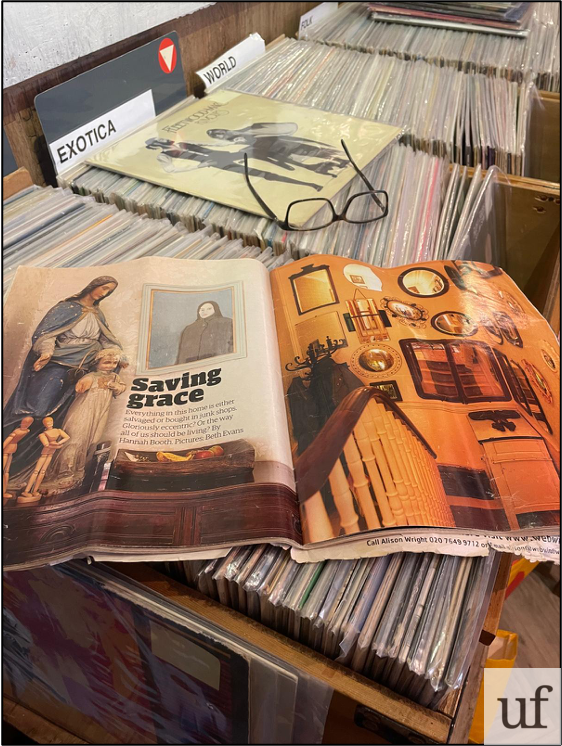
“We live in other people’s pasts,” said the anthropologist Elizabeth Tonkin. Though I was not aware of it at the time, as I stood in Mark’s record shop I was adrift in an archive of moments, feelings and emotions contained within objects.
If all we wanted was music, surely we would stick to streaming?
“Maybe it’s to do with the originality of the thing,” Tommy said. “The act of taking the record out the sleeve and putting on the turntable… that kind of ritual.”
Maybe it’s the obscure artwork, the hidden tracks or the weight of the disc itself. Maybe it is the imperfection: “I love that crackle,” one customer exclaimed as Mark flipped a record onto it’s B-side.
It’s never just the music.
It is the connection with times and spaces, whether they be bygone dance-floors or your parents first flat. It is the affection with people both known and unknown.
“There is something about records that will never die,” said Mark. “You can feel it in the objects themselves. Objects resonate.”
So is it us that visits the past, or does it visit us? More to the point, maybe, is the past ever really consigned to being just that? Or does it return through love notes written on record sleeves, scratches endured when moving house and vinyl sold in times of struggle?
Ask yourself that the next time you pick one up.
Maybe it’s better than drugs.
In the time between researching and publishing this story, Mark’s record shop has closed, making way for a gym.
But just as the past crackles through into the present, so too do the sounds, smells and smiles of Mark’s record shop slide onto the discs that I once pulled from those busy boxes and spin in my bedroom.
Long live Mark’s record shop.