

In the Rip-Curl
What is the role of a 142-year old youth club in 2026?
“It’s the first thing people say when there’s some mad behaviour that goes viral,” Danny said, cutting above the mechanic whirr of a coffee machine. “You see a bunch of kids rushing down Clapham High Street, raiding M&S, and people go: ‘Where are all the youth clubs?!’”
Some observers have viewed such examples of youth unrest as evidence of a sort of a moral deterioration, others as the result of growing isolation and mental health challenges among young people. In most cases, however, eyes have increasingly turned to the spaces where youth clubs once stood in search for answers.
For youth workers like Danny, however, and the 142-year old South London youth club where he works, the answers were never found in bricks and mortar.
The A-Word
“We had this great two-and-a-half year window from about 2006 – and then bang,” Danny said.
Danny Vance is a Senior Youth Worker at Alford House in Kennington, a role that follows a two-decade career spanning South London.
“When I started in Peckham in 2013, there were about eight or nine youth provisions in the area,” he said. “When I left in 2017 there were two.”
After securing a narrow victory in the 2010 General Election, David Cameron’s Conservative government sold austerity as a necessary measure to cope with the fallout of the 2008 financial crash. George Osborne – Cameron’s Chancellor and the architect of austerity – frequently justified the cuts as ‘Britain living within its means.’ Danny experienced them differently.
“It was the biggest gross act of wealth redistribution from the working class to the rich that we’ve ever seen,” he said.
Austerity led to the closure of 101 youth clubs in London between 2011-2020, according to London’s City Hall. The destabilising impact of these closures were laid bare in lower-income areas with less formal economic opportunities for young people.
“If we weren’t there, what would some of these young people have been doing from three to eight?” said Danny. “You’ve got this four or five hour gap where you can see the predatory nature of a tough area kick in.”
According to the Institute for Fiscal Studies, young people in areas with youth club closures are 14% more likely to commit crimes.
But is it accurate to pin all of society’s hopes on youth clubs? According to Danny, doing so would actually overlook the broader ocean of cultural and economic pressures in which young people swim.
From Drill to the Manosphere
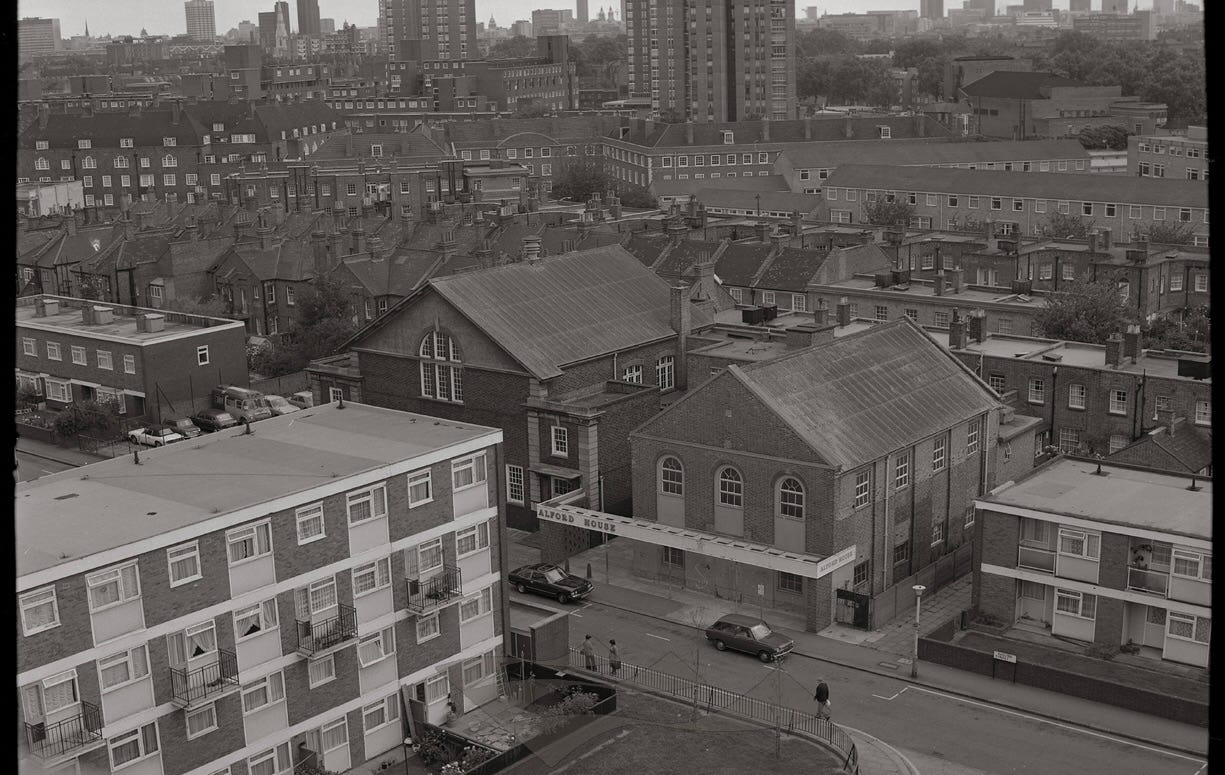
Founded in 1912 and 1884 respectively, Peckham’s Bradfield Club and Kennington’s Alford House – Danny’s former and current places of work – have seen off trends, musical genres, governments, monarchs, wars, welfare slashes and a pandemic.
What is the key? Funding, sure. An invaluable core of dedicated workers, of course. But also, Danny underlines, existing within the broader culture – instead of outside of it.
“It’s one of the clearest images I’ve got of how powerful culture is,” Danny said. “We had loads of TVs set up, PlayStations and all of that, but instead they were putting on YouTube and watching drill.”
Danny’s years in Peckham overlapped with the growth of drill music in popular culture. Whatever one’s views are on the controversial genre, the music and videography illustrated a version of economic success that felt tangible for young people when others didn’t.
“They were their preachers,” Danny said. “Their prophets. The ones that were teaching them how to make it out of this life.”
Drill culture did not exist outside of the youth clubs but was strongly intertwined within them. Recognising that overlap, Danny explained, is essential in truly identifying and understanding the lived experiences of young people in lower-income areas.

“It is one of the biggest myths around poverty,” Danny said. “You cannot separate the economic situation of a young person growing up in a poor area and the opportunities and what they’re willing to do to get out of that situation.”
The same, he argued, applies for the appeal of the manosphere. “A lot of the challenges facing young men are going to be economic,” he said. “With the manosphere it’s often the illusion of wealth that it comes back to. What are you going to do for money?”
Danny emphasised that, throughout his career and the trajectory of Alford House, the different cultural and economic pressures facing young people have always derived from a much larger social, economic and politics structures. So, what is the role of youth clubs within that context?
Lifeguarding
The economic and cultural pressures facing young people, while universally pervasive, are not experienced equally.
“I call it the rip-curl effect,” Danny said. “You might swim in a normal ebb and flow tide – if you swim too deep you have enough lifeguards to save you and you can probably swim back. That is privilege.”
“When I went to Australia, I experienced the rip-curl tide, where you take two or three wrong steps and you’re hallway in the ocean,” he said. “You step in and feel a violent push behind you, so there are lifeguards every five metres blowing the whistle, telling you to come back in.”
For young people with less opportunities and support systems, becoming lost at sea is often only a few steps away. Having someone there - blowing the whistle - can be a matter of life and death.
“That is our job,” he said. “That is why youth clubs are so important.”

It is not the role of youth clubs to stem the tides, but to help young people to cope with them.
“As a youth club, you can do everything to try and negate the kind of culture you’re in,” Danny said. “But the most important thing we can do is give them space to talk to trusted adults, because it’s not school, it’s not home, it’s your third space.”
Whether it be through music, sport, arts, or simple conversations: the answers lay not in the youth clubs themselves, but in the young people who go to them.
“Some of the kids we worked with are dead or in prison,” Danny said, with a sobering pause. “Maybe we couldn’t help them, but we may have stopped two or three others who were on the fringes from joining them.”
MM